Story
For some patients, it is not about wanting a completely different nose. It is about wanting a smoother profile, a little more structure through the bridge, and a result that feels elegant rather than obvious.
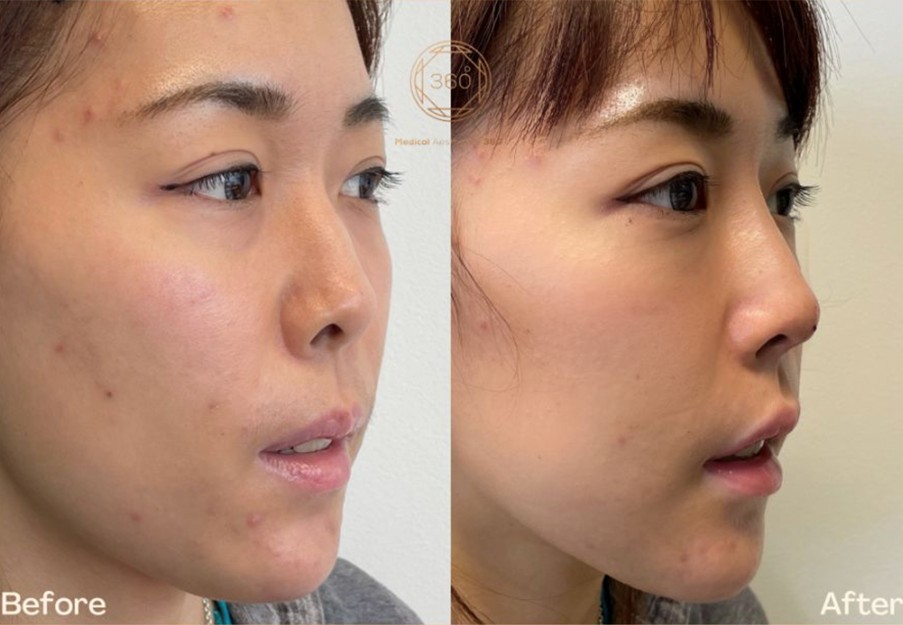
This patient came to Medical Aesthetics 360 with two main concerns: she wanted better bridge definition and also hoped to improve the appearance of a bump along the nose. What bothered her most was the side profile. She felt the nose lacked smoothness and balance, and she wanted a more refined contour without moving straight to surgery.
During consultation, our doctor assessed the nose carefully, including bridge height, skin thickness, profile shape, support, symmetry, and the nature of the dorsal bump. Different non-surgical options were discussed, including volumising support and PDO threads, with the pros, limitations, and safety considerations of each explained in detail.
For this case, thread-based support was discussed as the preferred option. This was because, in selected patients, it may provide a more structured bridge result, may avoid the broader appearance that can sometimes occur when added volume accumulates over time, and may also offer a different procedural experience from purely volumising approaches. Safety was an important part of the conversation, particularly because the nose is a high-risk area anatomically and requires careful assessment, planning, and technique.
The patient appreciated that the consultation was not rushed and that the discussion covered not only appearance, but also longevity, comfort, and risk profile. She wanted a result that looked refined and balanced, while still natural to her face. Following assessment, a personalised treatment plan was recommended with the aim of improving bridge definition and creating a smoother nasal profile.
Visible Results
At review, the nasal bridge appeared more defined and better supported, with a smoother transition along the profile. The bump looked less noticeable, and the overall nasal contour appeared more refined and balanced.
Rather than looking overcorrected, the result sat naturally within the rest of her facial features. The bridge looked cleaner and more structured, helping the nose appear more elegant from the side view while maintaining facial harmony.
This case highlights how non-surgical nasal refinement may be approached in carefully selected patients, particularly when the goal is subtle improvement in bridge shape and profile balance rather than dramatic change.
Doctor
Dr Suzanna Yan Ning Luo
AHPRA registration number: MED0001187471
Registration type: General and Specialist Registration – General Practice
Dr Chun-Yen Huang
AHPRA registration number: MED0001187421
Registration type: General and Specialist Registration – General Practice
Consultation, assessment, and treatment planning at Medical Aesthetics 360 are performed by our doctors, with treatment suitability determined following individual clinical review of anatomy, goals, and risk considerations.