


Facial volume and fat loss
We assess whether hollowing or reduced structural support is contributing to the concern. When volume loss is dominant, tightening alone may give a limited or unbalanced result.
Thermage FLX Sydney | Hurstville | Chatswood
At Medical Aesthetics 360, treatment starts with a suitability assessment—not an assumption that one device is right for everyone. We look at facial volume and fat loss, skin laxity and crepiness, tissue position, your comfort level and the result you want, then discuss whether Thermage FLX or another option is more appropriate.
Thermage FLX is a non-surgical radiofrequency treatment used to support firmer, smoother-looking skin. We plan treatment around two distinct areas: the delicate skin around the eyes and the broader face, jawline and neck.
Our suitability assessment
A device cannot decide suitability on its own. Medical Aesthetics 360 evaluates the source of the change you see in the mirror, how your tissues respond to gentle support and whether the likely benefit matches your priorities.
This distinction matters: skin laxity, facial fat loss and tissue descent can look similar, but they may need very different treatment strategies.
We assess whether hollowing or reduced structural support is contributing to the concern. When volume loss is dominant, tightening alone may give a limited or unbalanced result.
We look at where the tissues have softened or descended, how mobile they are and whether gentle repositioning changes the appearance of the area.
Fine wrinkling, skin thickness, sun damage and collagen quality influence which areas may respond and how gradual the expected change may be.
Heat sensitivity, treatment area, anxiety and previous experiences are discussed so pacing, communication and comfort measures can be planned around you.
Thermage is generally considered for gradual, non-surgical firming. We clarify whether that profile matches the degree of change you want to achieve.
We compare Thermage FLX with ultrasound, other radiofrequency treatments, skin-quality procedures, structural support or surgical referral where relevant.
Doctor-led planning
Thermage FLX can be used for a range of tightening goals, but the planning is different for the eyes compared with the face. The eyelid area is thin, expressive and unforgiving. The lower face and neck involve broader skin laxity, collagen quality, facial support and sometimes volume change.
At Medical Aesthetics 360, the consultation looks beyond the device name. We consider skin thickness, the pattern of laxity and crepiness, facial volume and fat loss, tissue position, eye and medical history, downtime tolerance and comfort preferences. We also explain why Thermage FLX may be suitable, when another option may be better, or when a staged combination plan may be more appropriate.
Pathway 01
Eye-area Thermage is for patients whose main concern is fine wrinkling, crepey skin or early laxity around the upper eyelids, lower eyelids or outer eye area. Thermage eye tips are specialised accessories for smaller, delicate periocular zones, and suitability must be assessed carefully.
This pathway is especially relevant when someone wants a fresher-looking eye area without surgery, but it is not the same as a blepharoplasty and it is not the answer for every under-eye concern.
Pathway 02
Face-focused Thermage FLX is usually discussed when the concern is mild to moderate skin laxity, reduced firmness, early jawline softening, neck crepiness or a gradual loss of collagen support. It may suit patients who want non-invasive tightening and a refreshed direction without looking abruptly changed.
It is also important to know when Thermage is not enough. Heavier jowling, significant neck laxity, marked volume or fat loss, or stronger facial descent may need a different or staged plan, such as skin tightening treatment planning, cheek support, jawline definition or other doctor-led options.
Treatment areas
Thermage FLX is most compelling when the concern is skin quality and firmness rather than a need for surgical lifting or significant volume replacement. Medical Aesthetics 360 separates the assessment into zones so the recommendation is more precise.
For selected patients with fine wrinkles, crepey eye skin or early laxity around upper and lower eyelids.
For patients wanting firmer-looking facial skin and gradual collagen support without a surgical pathway.
For early softness where tightening support may improve the look of lower-face definition.
For selected neck laxity, crepey texture and reduced skin firmness where radiofrequency is appropriate.
For selected body concerns where firmness, rather than fat volume alone, is the main issue.
For patients who benefit from skin tightening, skin quality work, resurfacing or structural support together.
How it works
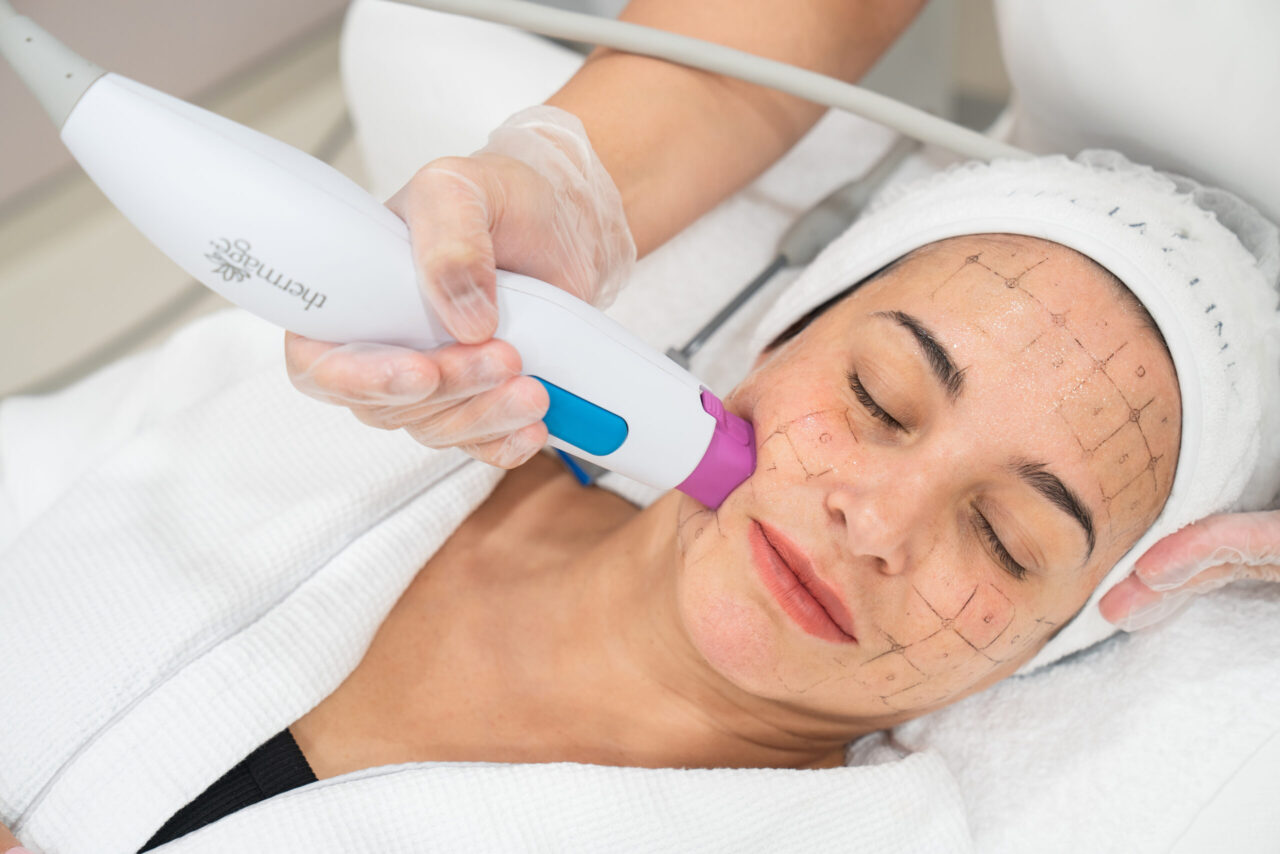
Thermage FLX delivers controlled radiofrequency energy into collagen-rich tissue below the surface while cooling helps protect the outer skin. The heat response is intended to support immediate collagen contraction in some patients and progressive collagen remodelling over time.
This is why Thermage is usually described as a gradual tightening treatment rather than an instant facial transformation. A systematic review indexed on PubMed found that monopolar and bipolar radiofrequency devices can produce measurable improvements in facial and body skin laxity, while outcomes and treatment suitability still vary between patients. The goal is a firmer, smoother and more supported appearance that still looks like you.
Timeline
Some patients notice early firmness, but visible improvement often develops over two to six months as collagen remodelling progresses. Longevity varies with age, baseline laxity, skin quality, lifestyle, sun exposure and maintenance planning.
Many patients like the subtle timing because the change does not look sudden. It reads as better skin support rather than a treatment announcement.
Technique and comfort
Facial tissues do not sit the same way in every person. During assessment, we observe how the skin and soft tissues rest, where they have become mobile and how the area changes with gentle support. This helps us decide the direction and pattern of treatment rather than applying energy in a generic grid.
During treatment, appropriate tissue support or repositioning may help maintain consistent contact and direct treatment across the intended area. Along with careful pacing, cooling and ongoing feedback, this can support a more comfortable and precise treatment experience. The technique is individualised, and comfort and outcomes still vary.
Compare options
The best skin tightening treatment in Sydney depends on anatomy, energy depth, eye-area goals, skin texture, downtime tolerance and whether the concern is laxity, volume loss or surface quality.
| Treatment | Often discussed for | Key difference |
|---|---|---|
| Thermage FLX | Mild to moderate laxity, skin firmness, collagen support and selected eye-area wrinkles. | Non-invasive monopolar radiofrequency, with special relevance for Thermage eye tips and selected upper and lower eyelid concerns. |
| Ultherapy PRIME | Brow, lower face, under-chin and neck support where ultrasound-based planning is relevant. | Uses focused ultrasound rather than radiofrequency. Compare with Thermage vs Ultherapy PRIME. |
| Sofwave | Skin firmness, fine lines and mild to moderate laxity in appropriate zones. | Uses synchronous ultrasound technology. See Sofwave Sydney. |
| XERF | RF-based firmness, lower-face support and customised tightening planning. | Another radiofrequency pathway; compare XERF vs Thermage. |
| Morpheus8 | Texture, acne scarring, pores and tightening where microneedling RF is appropriate. | Uses needles and has a different skin-surface profile compared with non-invasive Thermage FLX. |
Sydney clinics
Medical Aesthetics 360 provides doctor-led cosmetic, skin and laser planning for patients across Sydney, including the St George area, the North Shore and surrounding suburbs.
Our Hurstville clinic welcomes patients from the St George area and across Sydney for doctor-led Thermage FLX and skin-tightening consultations.
41-43 Dora Street
Hurstville NSW 2220
Our Chatswood clinic is convenient for patients from the North Shore and greater Sydney who would like to compare Thermage FLX with other suitable tightening options.
Suite 203/38B Albert Avenue
Chatswood NSW 2067
Internal guide
Thermage FLX often sits beside other skin tightening, eye rejuvenation and facial support options. These pages help you compare pathways before consultation.
FAQ
These answers are general education. Your suitability, treatment areas, risks, recovery and expected response are discussed during consultation.
Thermage eye tips are specialised accessories used for selected Thermage treatments around the eye area. They are designed for smaller, delicate periocular zones, including suitable upper and lower eyelid concerns.
Thermage FLX may be used for non-invasive treatment of wrinkles around the eyes, including upper eyelids in suitable patients. Eyelid anatomy, degree of hooding, eye history and brow position all influence whether it is the right option.
Thermage may be considered for selected lower eyelid wrinkles or crepey skin. If the concern is hollowing, tear trough shadowing or significant under-eye volume loss, a different under-eye treatment may be more relevant.
Thermage FLX may be suitable for selected patients with crepey eye-area skin where controlled radiofrequency heating and collagen support are appropriate. It is not a replacement for surgery where excess skin is significant.
Some patients may notice a more supported look around the brow or upper eyelid area, but the treatment is best framed as skin tightening and collagen support rather than a surgical brow lift.
Thermage FLX is commonly planned as a single-session treatment for a selected area, with maintenance timing discussed according to skin quality, age, laxity and goals.
Some patients see early firmness, but visible improvement usually develops gradually over two to six months as collagen remodelling continues. Individual results vary.
Many patients return to normal daily activity soon after treatment. Temporary redness, swelling or tenderness can occur and should be discussed during consultation.
Patients often describe cycles of heat, cooling and vibration. Comfort varies by treatment area, settings and individual sensitivity. Medical Aesthetics 360 discusses your comfort level beforehand and uses feedback, pacing, cooling and appropriate tissue support or positioning to guide the treatment experience.
We assess what you want to improve, the degree and location of skin laxity or crepiness, facial volume and fat loss, tissue position and mobility, medical history, comfort preferences and whether Thermage or another treatment is more appropriate.
The way facial tissues sit and respond to gentle support can help us plan treatment direction, contact and energy delivery. Where appropriate, controlled tissue positioning may support treatment precision and comfort. It does not replace structural support or surgery when volume loss or laxity is more significant.
Not always. Thermage, Sofwave and Ultherapy PRIME use different energy profiles and suit different anatomy and goals. Thermage is particularly relevant when radiofrequency tightening and the delicate eye area are priorities.
They are different treatments. Thermage FLX is non-invasive radiofrequency, while Morpheus8 is microneedling radiofrequency and may be more relevant for texture, pores, acne scars and certain tightening goals.
Medical Aesthetics 360 provides Thermage FLX consultation for Sydney patients, including those searching in Hurstville, Chatswood, the North Shore, St George and surrounding suburbs.
Next step
If you are comparing Thermage FLX for the eyes, face, jawline or neck, Medical Aesthetics 360 can assess your facial volume, fat loss, crepiness, tissue position and comfort preferences. We will explain whether radiofrequency tightening is suitable, how treatment could be tailored, and which other pathways deserve consideration.
Suite 203/38B Albert Avenue, Chatswood NSW 2067
41-43 Dora Street, Hurstville NSW 2220
Information on this page is educational and does not replace an individual medical consultation. Suitability, risks, treatment areas, recovery, costs, maintenance and expected outcomes vary between patients and should be discussed with a qualified practitioner before treatment.