


Not every bump sits at the same depth.
Even within one cluster, some syringomas can be flatter, deeper or shaped differently from their neighbours.
Syringoma treatment · Chatswood & Hurstville
Syringomas are harmless little bumps that commonly gather beneath the eyes—but they often sit deeper in the skin than they appear. At MA360, we offer two careful treatment options, Erbium:YAG laser and Agnes RF. For many suitable cases, we prefer Erbium:YAG because it gives us precise, visible control as each bump is reduced. Doctor-led assessment is available at our Chatswood and Hurstville clinics.
What syringoma actually is
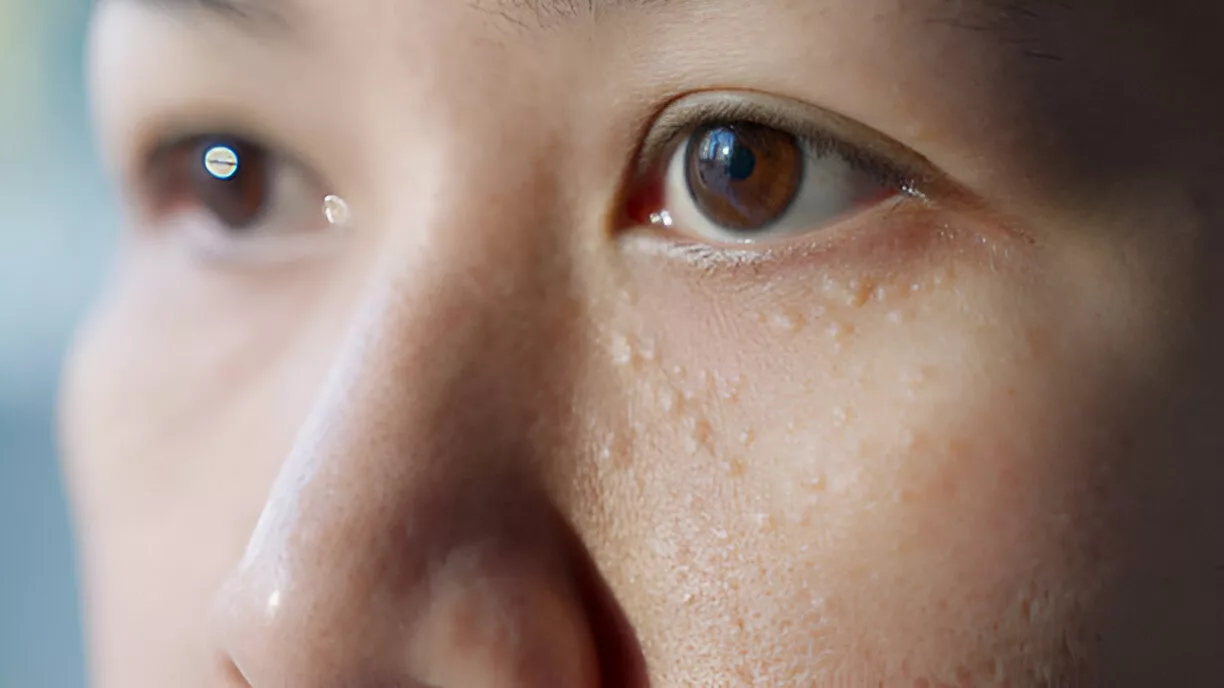
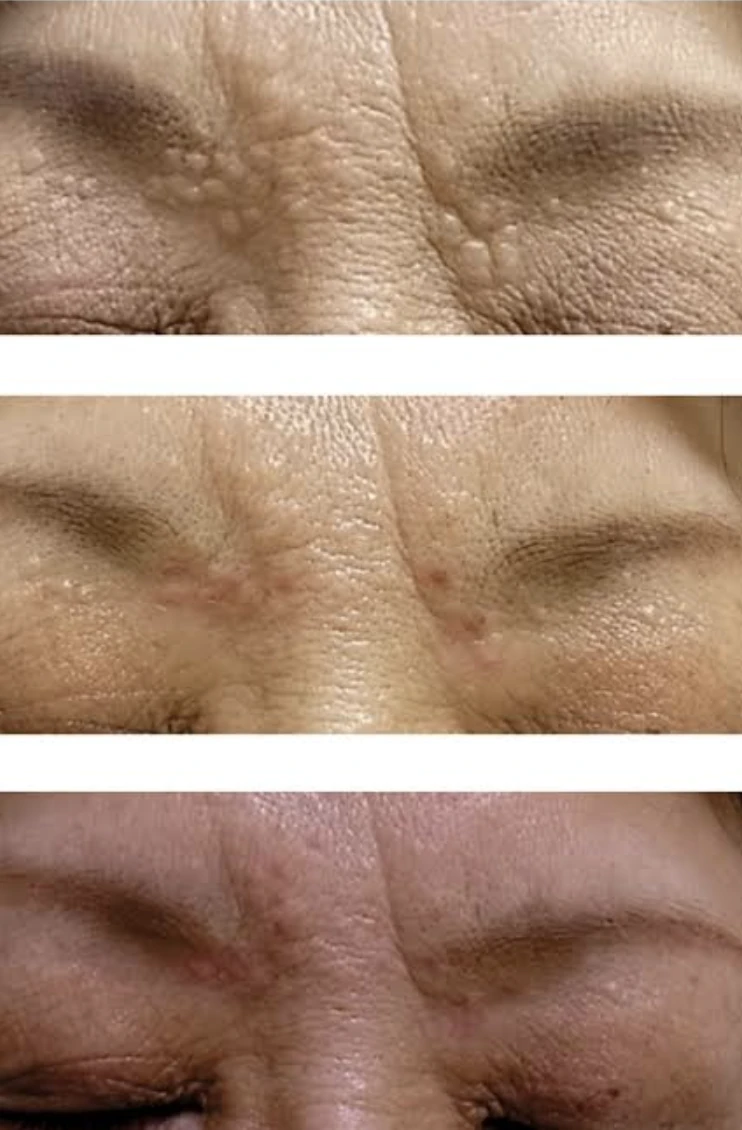
Syringomas are benign growths from the sweat ducts. They usually appear as several small, skin-coloured or pale bumps beneath the eyes.
The important point is that the visible bump is only the part you can see. The ductal component extends into the dermis—the supportive layer beneath the surface. This is why syringomas can return, and why trying to remove every last cell in one session can create more risk than benefit.
Treatment is cosmetic and completely optional. Our aim is to make the bumps and uneven texture less noticeable while respecting the thin eyelid skin—not to promise a perfect, permanent erasure.
Australasian College of DermatologistsDiagnosis comes first
Milia and several other common eyelid bumps can look similar to syringomas. Yellow xanthelasma plaques, tiny fluid-filled cysts and some less common skin growths need a different plan. Occasionally, a bump that looks harmless should be investigated rather than treated immediately.
We look at where the bumps sit, how they are grouped, their colour and surface, how long they have been present and whether they have changed. If the pattern is unusual or the diagnosis is uncertain, a biopsy or another medical opinion may be safer than immediate cosmetic removal.
The question of depth
Research helps us understand where syringomas can sit, but safe treatment cannot be reduced to one standard machine setting or a fixed number of micrometres.
A pathology study of 94 syringomas found that periocular lesions reached an average depth of about 1.17 mm. The measurements varied enormously. In practical terms, this means a practitioner should respond to the individual bump and the skin—not chase a single pre-set depth.
Even within one cluster, some syringomas can be flatter, deeper or shaped differently from their neighbours.
The effect of Erbium:YAG changes with the setting, pulse, spot size, overlap and the tissue itself. The number on the screen does not replace clinical judgement.
We work layer by layer, watching how the bump and surrounding skin respond. The aim is visible improvement, not digging out every possible duct at any cost.
Erbium:YAG energy is absorbed very strongly by water in the skin. This allows thin layers to be removed precisely with less lingering heat than a CO₂ laser. That control is especially attractive around the eyes, although careful judgement still matters.
Read the resurfacing reviewWhy Erbium:YAG often wins our vote
We do not prefer Erbium:YAG because it sounds stronger or newer. We prefer it in many suitable cases because it lets us see and control what we are doing.
When the bumps are clearly visible and accessible, Erbium:YAG lets us reduce the raised part directly, adjust the treatment from one bump to the next and gently blend the edge into the surrounding skin. Its strong water absorption also means less residual heat than a CO₂ laser.
This suits our approach: make a careful first improvement, allow the skin to heal, then decide whether anything more is worthwhile. Agnes RF remains a useful alternative when the pattern or depth makes a needle-based approach more sensible.
What happens at MA360
We confirm whether the pattern is consistent with syringoma and look for anything that needs biopsy or another opinion before cosmetic treatment.
Lesion size, projection, density, eyelid location, skin type, pigment history and previous treatment guide the choice of device and treatment intensity.
The comfort and eye-protection plan is selected for the treatment zone. Local anaesthesia may be used. Periocular laser treatment requires appropriate wavelength-specific ocular protection.
Selected lesions are reduced with Erbium:YAG or targeted with Agnes RF. Dense clusters may be staged rather than treated aggressively in one sitting.
We assess improvement after the skin has settled. Residual or recurrent papules can be discussed without assuming that more treatment is always worthwhile.
Recovery and expectations
Tiny crusts or superficial wounds can form after treatment. Periocular swelling may be more noticeable the following morning.
Post-inflammatory darkening or lightening can occur and may last for weeks or months, particularly in more pigment-prone skin.
These are uncommon but real possibilities. Risk rises when treatment is deep, healing is impaired or the area is repeatedly picked or irritated.
Deeper ductal structures can persist. Improvement may be incomplete, and new or recurrent papules can appear over time.
Aftercare matters
Keep the area protected, avoid picking, use the recommended wound care and follow the personalised sun-protection plan. Contact the clinic if pain, swelling, redness or discharge is worsening rather than settling.
What the evidence can—and cannot—say
Clinical overview of diagnosis, dermal location, treatment choices, recurrence and healing.
Erbium:YAGAblative laser resurfacing reviewExplains 2940 nm water absorption, precise ablation and the narrower thermal injury zone.
Insulated microneedle RF55-patient retrospective analysisApproximately half had marked resolution after one treatment; clearance increased with repetition.
Intralesional RF64-patient clinical seriesReported increasing improvement across up to three sessions of intralesional RF ablation.
Pathological depth94-patient syringoma analysisQuantifies wide variation in lesion depth and supports individual, conservative planning.
Laser histologyFractional Er:YAG ablation-depth studyShows why pulse, energy and stacking alter tissue depth—and why there is no single depth recipe.
Frequently asked
Individual advice depends on confirming the diagnosis and examining the eyelid skin.
No treatment can guarantee permanent clearance. Syringomas extend into the dermis and may recur after laser, radiofrequency, electrosurgery or excision. Our aim is a worthwhile cosmetic reduction while protecting the surrounding eyelid skin.
The 2940 nm Erbium:YAG wavelength is strongly absorbed by water, allowing controlled layer-by-layer ablation with relatively limited surrounding thermal injury. For visible, discrete papules, that direct visual control often makes it our preferred first option. Suitability still depends on the diagnosis, depth, distribution, skin type and previous treatment.
Agnes RF uses a fine insulated needle to place radiofrequency energy within a selected lesion. It may be considered when a deeper intradermal approach is useful, when minimising surface ablation is a priority, or for selected persistent lesions. It can require repeated treatment and is not automatically better for every cluster.
There is no universal safe depth in micrometres for every syringoma. Eyelid thickness, lesion architecture, device parameters and tissue response vary. We use conservative, visually assessed layer-by-layer treatment rather than chasing a predetermined depth or the entire dermal duct.
Small crusts, redness and swelling are expected. Published Australian dermatology guidance describes healing after ablative laser treatment commonly taking about 5 to 14 days, although the exact course varies with treatment area and intensity. Redness or pigment change may persist longer.
Doctor-led syringoma assessment and suitable treatment are available at Medical Aesthetics 360 in Chatswood and Hurstville. The Chatswood clinic is at Suite 203, Level 2, 38B Albert Avenue, and the Hurstville clinic is at 41–43 Dora Street.
A considered first step
Book a doctor-led assessment at MA360 in Chatswood or Hurstville. We will discuss the diagnosis, the realistic degree of reduction, Erbium:YAG, Agnes RF, healing and the option of leaving benign syringomas untreated.
Suitability is assessed individually. Results vary. Treatment cannot guarantee complete clearance or prevent recurrence.
↑ Back to the beginning