


Thin, elastic skin
Finer upper-lid skin with good elasticity can fold more cleanly and place less downward load on buried fixation.
Sometimes referred to as non-incisional blepharoplasty, this specialised buried-suture technique can create a defined, responsive double eyelid fold without a long external crease-line incision. For the right eyelid, the aim is a result that looks balanced, soft and naturally yours.
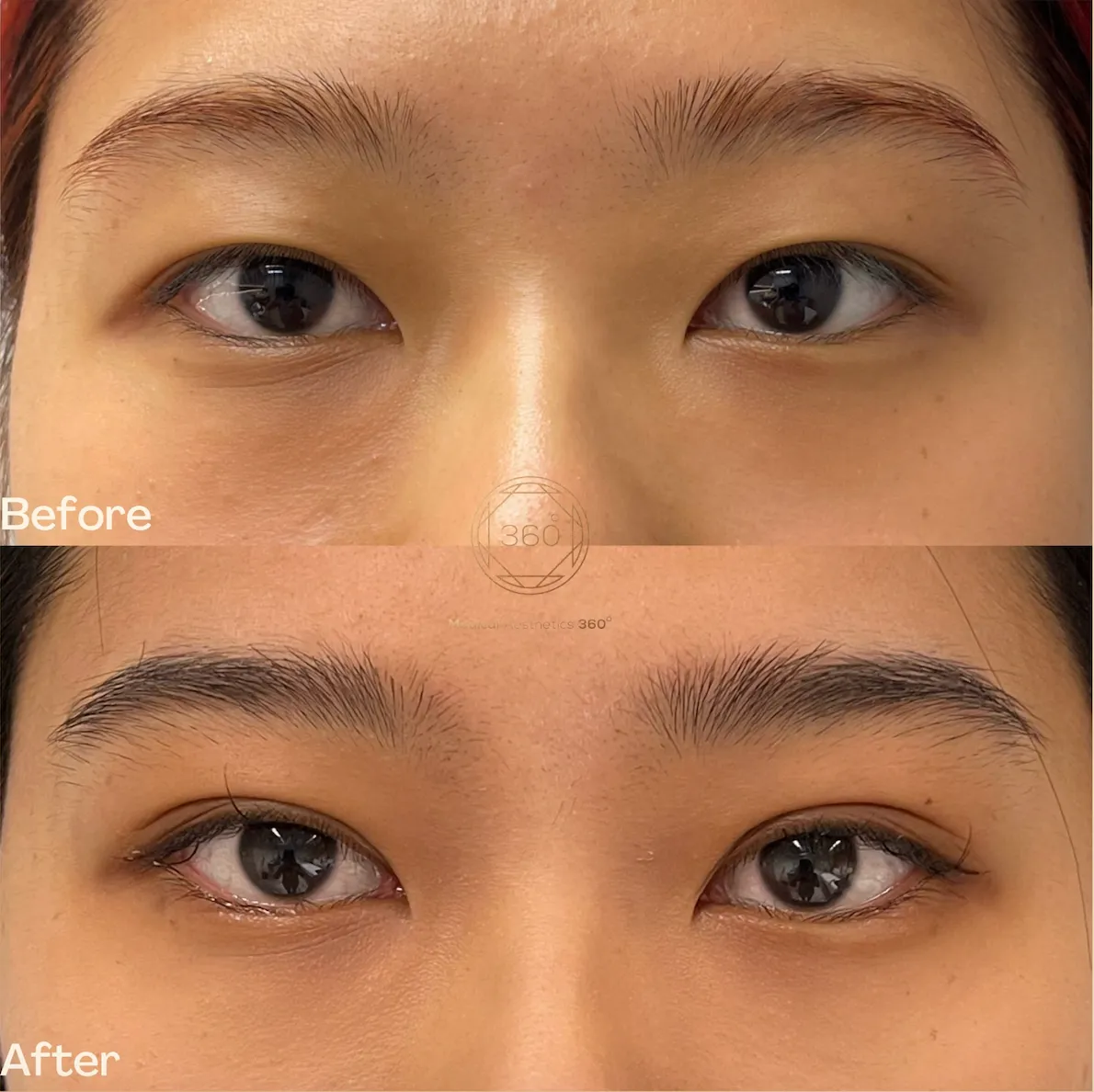
Maybe your crease disappears through the day, eyelid tape never sits evenly, or one eye looks more defined than the other. You may want a cleaner eyelid fold, more visible lid space for makeup, or simply a more defined eye shape—without changing the features that still need to feel like you.
Suture double eyelid surgery—sometimes described as non-incisional blepharoplasty—creates a discreet connection between the upper-lid skin and deeper eyelid structures. When the anatomy is suitable, the skin forms a natural fold as the eye opens, without a long incision across the crease. The goal is a soft, mobile fold that works with your natural eye shape rather than overpowering it.
The real difference is not the suture alone. It is choosing the right candidate, the right crease height and the right fixation pattern for that individual eyelid.
A less invasive approach is only the better choice when it matches the tissue. MA360 assesses the skin, fullness, eyelid-opening function, brow position and crease behaviour before recommending a technique.
Finer upper-lid skin with good elasticity can fold more cleanly and place less downward load on buried fixation.
A light, non-puffy lid is more likely to form a stable crease without requiring tissue removal through an incision.
The fold must work with the levator, brow position, inner corner and natural asymmetry—not fight against them.
During your assessment, the proposed crease can be gently simulated at different heights and shapes while you look ahead, blink and relax. We assess it with the eyes open and closed, then refine the inner and outer sweep so the design follows your eye rather than a preset formula.
For a well-selected suture candidate, this preview can be a very useful guide and is often close to the settled crease. It cannot be an exact promise: swelling, natural asymmetry, tissue response and healing still influence the final result.
Book my crease design assessmentMA360’s anatomy-led fixation plan is adjusted point by point to create a smooth crease that forms as the eye opens and relaxes naturally when it closes.
The proposed crease is marked in relation to your lash line, eye opening, brow, inner corner and natural side-to-side differences.
You review how the fold may appear at rest, while blinking and with the eyes fully open before the plan is finalised.
Under anaesthetic, fine sutures are buried through tiny entry points to connect the skin with deeper eyelid structures.
Crease height, continuity and movement are checked, followed by tailored aftercare and planned clinical review.
The aim is to choose the least invasive method that can reasonably create and maintain the intended fold. For some eyelids, that is a suture-based non-incisional approach; for others, an incision provides better access to the tissue that needs to be adjusted.
| What matters | Suture / non-incisional double eyelid | Incisional double eyelid |
|---|---|---|
| Best suited to | Thin skin, limited fat, little or no excess skin and suitable eyelid function | Thicker or fuller lids, excess skin, tissue removal needs or more complex revision |
| External incision | No long crease-line incision; tiny access points are used | A crease-line incision allows direct tissue adjustment |
| Early recovery | Usually less swelling and a faster return to social activity | Typically more visible swelling, bruising and scar maturation |
| Durability | Can be long-lasting and sometimes effectively permanent in a carefully selected lid, but loosening can occur | Generally the more reliable option when tissue must be removed or structurally rearranged |
| Revision | Suture removal or adjustment may be simpler, depending on the fixation used | Revision may be more involved because tissue and scar relationships have changed |
The epicanthal fold can influence how a double eyelid crease begins, how much of the inner eye is visible and whether a tapered or more parallel fold looks harmonious. If it strongly limits the intended design, epicanthoplasty may be considered at the same time as crease creation.
This is not an automatic add-on. Many eyes look most beautiful with their original inner-corner character preserved. If epicanthoplasty is likely to improve balance, MA360 will show you why, explain the additional incision and scar trade-off, and design it conservatively.
The goal is coherence: the crease and inner corner should read as one natural eye shape, never as two separate procedures.
Early recovery varies with the technique and your healing response. Discuss work, study and social commitments during assessment, and allow extra time if bruising or swelling remains visible.
The aim is a crease that suits your anatomy and moves naturally. Initial crease formation does not guarantee long-term stability: sutures can loosen, tissues change and further treatment may be needed.
Feeling ready for social activity is different from being fully healed. Crease depth, symmetry and movement can continue to change as swelling settles. Your clinician will explain the expected recovery and review plan for your procedure.
Suture-method recovery is often measured in days for social confidence, but the fold still needs weeks to soften and settle.
Swelling, tightness, watering, mild discomfort and unevenness are common. Follow the cold-compress, sleeping and medication instructions provided.
Many suitable patients are comfortable being seen by this stage. Bruising or puffiness may still be visible, especially up close.
The fold generally looks less deep and more natural as swelling settles. Early side-to-side differences often continue to improve.
Crease depth, flexibility and symmetry continue to refine. Review timing is tailored to your progress.
Knowing both sides makes it easier to choose with confidence. Your personal risk profile is discussed before consent.
The consultation is where these general answers become specific to your eyelids, your preferred crease, your recovery timeline and the result you want.
On this page, non-incisional blepharoplasty refers to the buried-suture double eyelid approach that creates a crease without a long external crease-line incision. It is different from incisional upper blepharoplasty, which may involve removing or repositioning skin, fat or other tissue. Terminology varies, so your consultation focuses on the actual technique your eyelid needs rather than the label alone.
It can be very long-lasting and may behave as a permanent crease in the right thin-lid candidate. It is not honest to promise permanence: sutures may loosen, attachments may weaken and skin, fat and brow position continue to change with age. If your tissue is heavy or lax, an incisional method may offer a more dependable structure.
The consultation simulation is usually a useful guide because it shows how your own skin folds at a proposed height and shape. In a suitable candidate, the settled result may be close to that preview. It cannot reproduce healing, swelling or fixation perfectly, so it should guide the plan rather than serve as an exact guarantee.
The suture method avoids a long external incision and uses tiny access points, which generally become inconspicuous. Any break in the skin can leave a mark, however, and pigmentation or small contour changes are possible. Epicanthoplasty involves a separate inner-corner incision and scar discussion.
Selected mini-incision techniques may allow limited fat adjustment, but a puffy or heavy eyelid can be a sign that a purely suture-based approach is not the most reliable option. Removing too much fat can create hollowing and an aged contour. The recommendation depends on which tissue is creating the fullness.
Yes, when the inner-corner fold materially limits the intended crease or eye contour. It is planned as part of the overall design rather than added routinely. Benefits must be balanced against the additional incision, scar visibility, redness and risk of under- or over-correction.
No face begins perfectly symmetrical, and no procedure can guarantee identical eyelids. Careful design and fixation can improve a visible difference, while small variations in eye opening, brow height and healing may remain. Early swelling can also temporarily exaggerate asymmetry.
Many suture-method patients plan several days away and feel socially presentable within one week. Choose more flexibility if your work is camera-facing or you bruise easily. “Presentable” does not mean fully healed; the fold will continue to soften over the following weeks.
A fold that weakens needs assessment to identify whether a suture has loosened, tissue has changed or the original method was not strong enough for the anatomy. Options may include observation, suture adjustment, repeat fixation or conversion to an incisional approach.
Preview your likely crease, compare non-incisional and incisional options, and leave with a clear plan designed around your anatomy, priorities and preferred level of definition.
Consultations are available at MA360 Chatswood and Hurstville. This page provides general information and does not replace individual medical or eye-care advice. Suitability, expected recovery, alternatives and risks are assessed personally. Results and recovery vary.